
ByJohn A
Choosing an Infrared Sauna the Whole Household Will Use for Beginners
A sauna that gets used by the whole household, not just the person who bought it, generally needs three things: enough interior space for the household’s typical group size, a temperature range flexible enough for different preferences and ages, and a location convenient enough that nobody skips a session because it is inconvenient to reach. Research on regular sauna use consistently points to frequency, not intensity, as the pattern tied to the outcomes studied, which makes a cabin the whole family will actually use more valuable than one built for a single power user.
The Evidence for Making It a Household Habit, Not a Solo One
A 2018 review in Mayo Clinic Proceedings and a 2018 systematic review in Evidence-Based Complementary and Alternative Medicine both describe consistent, frequent sauna use, several sessions a week over years, as the pattern associated with the cardiovascular and relaxation benefits most studied in Finnish cohorts. A cabin used by only one household member a couple of times a month is unlikely to replicate anything close to that pattern. A cabin sized and positioned so multiple people use it regularly, even on staggered schedules, has a better shot at the kind of consistent use the research actually describes.
Benefit: A Larger Cabin Removes the Scheduling Bottleneck
A one-person pod forces every household member onto a single-user rotation, which quietly kills consistency once four schedules are involved. A three- or four-person cabin lets two people sit together or lets sessions happen back to back without a long cooldown between uses. This is less about everyone sweating at once and more about removing the friction that causes people to skip a week because the sauna was “someone else’s turn” too often.
Benefit: Adjustable Temperature Ranges Keep Everyone Actually Using It
Preferences vary more than first-time buyers expect. A partner who runs warm may want 145 degrees while a teenager or older parent is more comfortable at 120. Cabins with independently adjustable panel zones handle this without argument, but most households manage fine with a simpler fix: setting a default in the middle of the range and letting individual users nudge it up or down for their own session. A cabin that only offers one fixed high setting is the kind that ends up used by one person and ignored by everyone else within a few months.
See also: Vinyl Signage Installation: How It Helps Improve Business Visibility
Benefit: Thinking About Kids and Older Adults Up Front Avoids Later Problems
Households with children or older adults benefit from a cabin that supports shorter sessions and lower presets without extra shopping. Most manufacturers recommend supervised, shorter, cooler sessions for kids, and a lower-temperature preset built into the control panel makes that easy to enforce consistently rather than relying on someone remembering to dial it down every time. For anyone in the household managing a heart condition, recent illness, or pregnancy, a conversation with a doctor before starting a routine is worth having regardless of how flexible the cabin’s settings are.
Benefit: Bench Layout Changes How Naturally People Use It Together
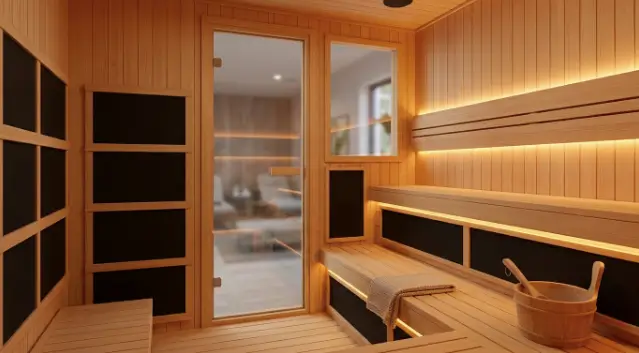
An L-shaped or two-tier bench layout lets two or three people sit at slightly different distances from the panels, which is more comfortable for mixed group sessions than a single straight bench facing one wall. This detail rarely shows up in marketing copy but matters more than square footage alone for whether a family actually sits together versus taking turns waiting outside the door.
Setting Ground Rules Early Keeps It From Becoming One Person’s Chore
The households that keep a sauna in regular rotation tend to set a light schedule early, who gets it on which evenings, how long a typical session runs, and who is responsible for the basic wipe-down after use. Skipping this conversation often means one person becomes the default owner of both the sauna and its maintenance, which is a common reason usage tapers off within the first year even with a well-chosen cabin.
Comparing Family-Sized Options Before Buying
Once space, temperature range, and bench layout are settled, comparing a few specific models on wattage, warranty, and interior dimensions is the last step. Sellers who carry a range of household sizes, including SweatDecks.com, list these details model by model, which makes it easier to compare a three-person cabin against a four-person one on the numbers that actually predict whether it fits a specific household rather than a generic “family size” label.
Benefit: A Shared Habit Tends to Reinforce Itself
Households that build a shared sauna routine often report it becoming a natural anchor for other habits, an evening wind-down before bed, a post-workout stop for whoever exercises together, or a weekend ritual that does not depend on anyone remembering to schedule it. This is not something the research measures directly, but it lines up with a broader pattern in behavior change: shared routines tend to be more durable than solo ones, because more than one person notices and mentions it when a week gets skipped. A cabin that only one household member ever uses does not get this reinforcing effect, which is one more reason sizing and placement decisions aimed at broad household use tend to pay off over a longer time horizon than a purchase optimized for a single user.
This also affects how a household thinks about placement. A cabin tucked into a rarely visited corner of a basement is easy for any one person to forget about, while one placed somewhere central enough to be part of the household’s normal evening path gets a built-in reminder every day, without anyone having to consciously schedule around it. Beginners choosing between two otherwise similar spots for a family cabin often do better picking the more visible, more convenient option over the technically ideal one that nobody walks past.
What to Avoid When Buying for a Household Instead of Yourself
The most common mistake is buying based on the preferences of whoever is doing the research, usually the household member most excited about the purchase, without checking in on what size, temperature range, and schedule would actually work for everyone else. A cabin that is technically large enough on paper but sized around one person’s ideal session length and heat preference can end up feeling like it belongs to that one person even if it was bought as a shared purchase. Involving the rest of the household in the size and feature decision before ordering, not just informing them after delivery, is a small step that meaningfully improves the odds of the cabin becoming a genuine household habit rather than one person’s solo project.
Frequently Asked Questions
What size infrared sauna works for a family of four? A four-person cabin gives each family member room without everyone needing to be in it at once. A three-person model is often sufficient if sessions are usually solo or in pairs.
Is it safe for kids to use an infrared sauna? Most manufacturers recommend shorter sessions and lower temperatures for children, with adult supervision throughout, and a pediatrician’s input for any underlying health condition.
How do you handle household members who prefer different temperatures? Some multi-person cabins offer zoned panels, but staggering sessions so each person sets their own preferred temperature is the simpler fix for most households.
Does regular family sauna use actually have evidence behind it? The strongest evidence comes from Finnish cohort studies linking frequent, regular use to lower cardiovascular and all-cause mortality risk, an association rather than a guarantee for any individual.
References
- Cardiovascular and Other Health Benefits of Sauna Bathing: A Review of the Evidence, Mayo Clinic Proceedings, 2018
- Clinical Effects of Regular Dry Sauna Bathing: A Systematic Review, Evidence-Based Complementary and Alternative Medicine, 2018
- Effects of heat and cold on health, with special reference to Finnish sauna bathing, American Journal of Physiology – Regulatory, Integrative and Comparative Physiology, 2018
By Renee Whitfield
